
- Check
- Leave noindex pages crawlable.
- Why
- Google can only see noindex if it is allowed to fetch the page. Disallowing the same URL in robots.txt hides the rule, and the URL can stay indexed.
- Verify
- For every template that sets noindex, confirm the path is not disallowed in robots.txt.
- Failure mode
- Someone adds both noindex and a robots.txt disallow "to be safe", and the pages stay in the index.
- Sources
- Named primary documents, listed on each page.
A reference library, 52 checks in 5 checklists
Technical SEO, as a checklist you can actually run.
Each item says what to check, why it matters, how to verify it and what usually goes wrong. Each one names the primary documentation it rests on, so you can read the source instead of taking our word for it.
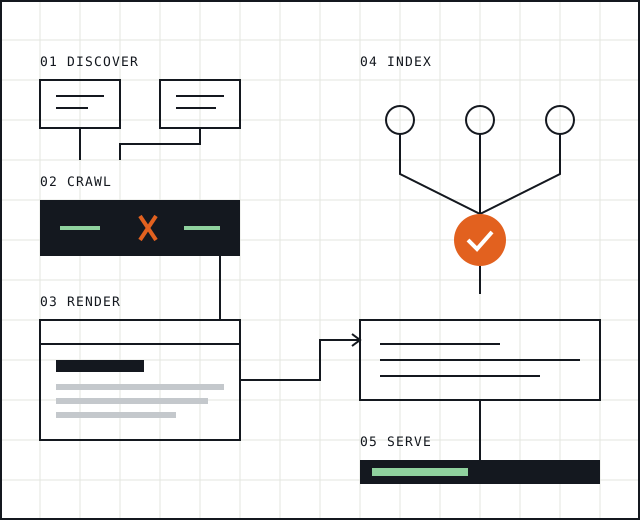
Where each checklist sits
Follow one URL from discovery to the results page
Most technical problems are a URL getting stuck at one stage. Start with the stage where it stops.
-
01
Discover
Links and sitemaps tell crawlers a URL exists.
Crawl access CA -
02
Crawl
robots.txt and server responses decide whether it can be fetched.
Crawl access CA -
03
Index
noindex and canonicals decide whether it is kept, and under which URL.
Index controls IC -
04
Move
Redirects carry a URL forward when it changes.
Redirects and migrations RM -
05
Describe
Structured data explains what the page contains.
Structured data SD -
06
Serve
Page experience is how the page behaves once someone opens it.
Page experience PX
How an item is built
Every check has the same five parts
The format is fixed so the checklists work as working documents. You can scan the checks, open the reasoning only where you need it, and hand the verification step to whoever owns that system.
Read the editorial policy for how items are sourced and dated.
Before a release
Eight checks worth running before any launch
One or two from each checklist, chosen because they fail quietly and are cheap to verify.
- CA-02Make robots.txt return 200 with text/plain, and know what other status codes mean.
- CA-05Do not use robots.txt to keep a page out of the index.
- IC-02Leave noindex pages crawlable.
- IC-05Give each indexable page one absolute, self-referencing rel=canonical.
- RM-01Use a server-side permanent redirect (301 or 308) for permanent moves.
- RM-04Map each old URL to its closest equivalent new URL.
- SD-04Mark up only content that visitors can see on the page.
- PX-01Know the three thresholds.
The library
Five checklists
| Code | Checklist | Use it when | Checks |
|---|---|---|---|
| CA | Crawl access | Launching a site, changing hosting or a CDN, editing robots.txt, or investigating pages that are discovered but not crawled. | 15 |
| IC | Index controls | Pages are indexed that should not be, when the wrong URL shows in results, or before launching faceted navigation, filters or a staging environment. | 10 |
| RM | Redirects and migrations | Use it before changing a URL structure, moving to a new domain or platform, switching to HTTPS, or consolidating several sites into one. | 10 |
| SD | Structured data | Adding schema.org markup to a template, when rich results disappear, or when a CMS plugin starts generating markup you did not write. | 9 |
| PX | Page experience | Search Console reports poor URLs, before a redesign or a new script is added, or when someone proposes a speed project to fix rankings. | 8 |
Plainly
What this site is not
- It is not an agency. Nothing is for sale here and there is no one to hire through it.
- It makes no ranking promises. Search engines decide rankings; a checklist only removes avoidable technical problems.
- It was drafted with AI assistance from named primary documentation and is awaiting human editorial review. More about the site.